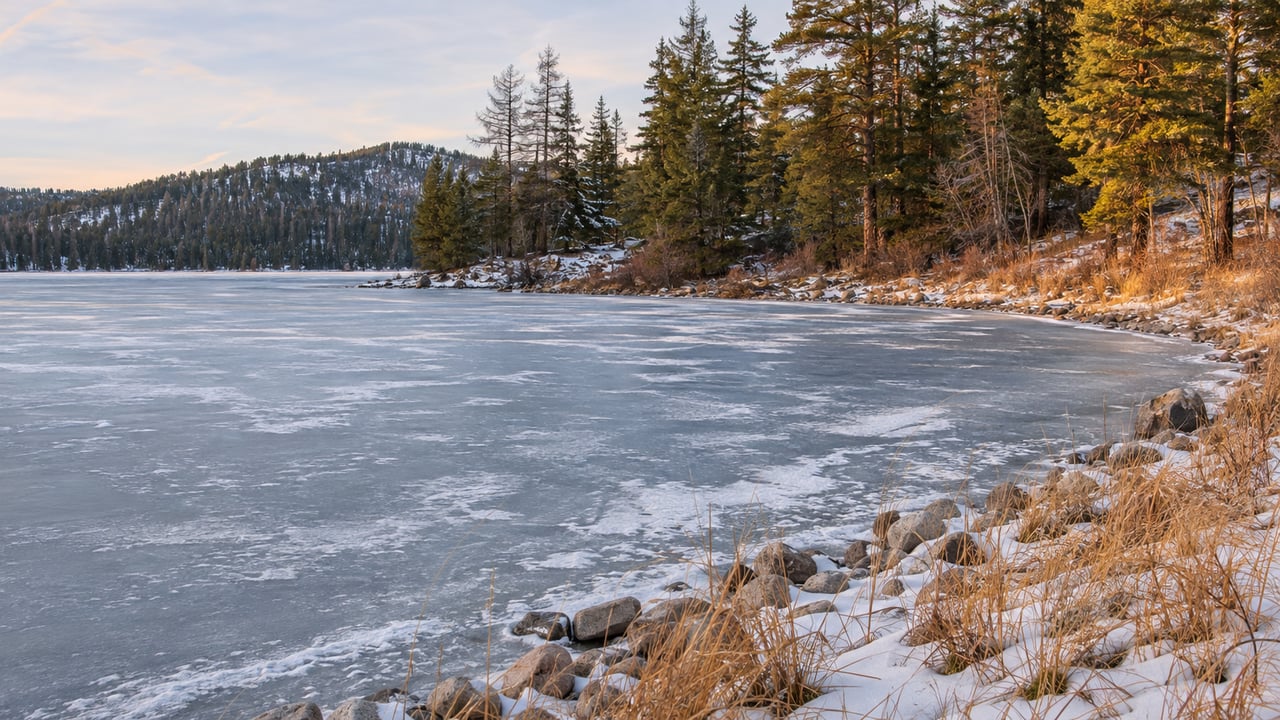
For years, most of the kokanee eggs behind northwest Montana's hatchery stocking have come from Lake Mary Ronan. Fish, Wildlife and Parks has collected about 2.5 million fertilized eggs there a year and raised them at local hatcheries. Little Bitterroot Lake, west of Kalispell above Marion, has a wild kokanee run of its own and has mostly been one more good lake to fish.
That is about to change. On Oct. 14, the Montana Fish and Wildlife Commission adopted the 2027–2028 fishing regulations, and three of the changes fall on the two big lakes around Marion. Two of them protect Little Bitterroot's fish. The third loosens the rules on McGregor Lake. All three take effect after this ice season, so this winter's fishing still runs under the current rules.
Why Mary Ronan's eggs ended up on Little Bitterroot
The Daily Inter Lake reported that northern pike have recently been introduced to Lake Mary Ronan and that rising autumn water temperatures there have put both the quantity and the quality of its kokanee eggs at risk. The same report called Little Bitterroot Lake the most viable alternative site for egg collection. FWP's own rationale is shorter. Warm fall temperatures have left Mary Ronan's egg quality poor, so the agency intends to move its kokanee brood source to Little Bitterroot.
FWP has been planning this for a while. In 2022, worried about possibly losing the Mary Ronan broodstock, it began looking at Little Bitterroot and Ashley lakes as backup sources. A 2023 Daily Inter Lake column on kokanee management reported that crews caught 120 adult kokanee from each lake in fall 2022 for health screening. Four years later, Little Bitterroot became the choice.
A brood lake has to do two jobs. It gives up eggs and milt every fall, and it still has to sustain its own wild fish. FWP's proposal says plainly that taking large numbers of eggs each fall would likely affect Little Bitterroot's wild kokanee. To offset that, the agency cut what anglers can keep, so that eggs and milt are available every year. The new limit is 10 kokanee daily and 20 in possession.
Not everyone agreed. Ian Wargo, the Region 1 commissioner, argued that the lake's kokanee could easily handle the agency's egg take, and he offered an amendment to keep the current limit. In the Daily Inter Lake's account, he said:
"Removing a thousand fish out of this lake for kokanee spawning, I don't think would even be noticeable, and I think it's another one-off regulation that, at this time, it's not necessary."
The commission voted the amendment down. The Flathead Beacon reported that the full package of 44 changes then passed unanimously, with two amendments on other waters.
The kokanee also go both ways. FWP's stocking plan for Little Bitterroot calls for 25,000 kokanee from the Flathead Lake Salmon Hatchery every year from 2026 through 2031. The lake will supply eggs, and on paper it is scheduled to get fish back.
This winter still runs on the 2026 rulebook
Montana's fishing season runs from March 1 through the following February. The current regulations are valid through the end of February 2027. The Daily Inter Lake describes the new set as going into effect in 2027. For anyone augering holes near Marion between first ice and late February, the change looks like this:
| Water and species | Under the 2026 regulations | Adopted for 2027–2028 |
|---|---|---|
| Little Bitterroot Lake, kokanee | 20 daily, the Western District standard | 10 daily and 20 in possession |
| Little Bitterroot Lake, rainbow trout | District standard for lakes: 5 trout daily, only 1 over 22 inches | 1 daily and in possession, 28-inch minimum |
| McGregor Lake, crayfish | 20 daily and in possession, egg-bearing females released | 100 daily and in possession, egg-bearing females released |
In the 2026 booklet, "Bitterroot Lake" points readers to the Little Bitterroot Lake listing, so derby flyers and regulation pages that use either name mean the same water. The full text of the current rules is in FWP's 2026 Fishing Regulations. The adopted changes are in the commission's proposal package.
The big rainbows now depend on wild fish
Little Bitterroot's other change is about a different fish, but it follows the same idea of protecting what the lake produces on its own. FWP says the lake's trophy rainbow fishery has been built on wild fish plus stocked Gerrard-strain rainbows. That stocking ended in 2024, and the agency expects the number of large fish to decline. FWP's stocking records for the lake show the last plants. Murray Springs Trout Hatchery released 5,123 Gerrard rainbows on April 30, 2024, and 20,023 more on June 10, 2024.
With no new Gerrard fish coming, FWP set a 28-inch minimum and a one-fish limit to help the lake's wild rainbow population persist and keep catch rates from falling.
McGregor Lake, where the limit goes up
Along US Highway 2, McGregor Lake's change goes the other way. The reason is that one of its signature catches turns out not to be native.
Signal crayfish have long been a popular catch on McGregor because there are plenty of them and they run large. Concerns about alleged illegal commercial harvest, waste of smaller crayfish, falling numbers and size, and a growing population of illegally introduced smallmouth bass led FWP to begin targeted crayfish monitoring there in 2019. In 2021, the agency set a special limit of 20 daily and required anglers to release females carrying eggs.
Those protections assumed the McGregor population might be native. FWP now says that native status has been refuted. The adopted rule raises the limit to 100 daily and in possession and keeps the requirement to release egg-bearing females. On McGregor, the 2027 season brings a crayfish limit five times the current one.
McGregor's public access is at its west end, where the Forest Service's McGregor Lake Campground has a boat ramp and 27 sites and lists ice fishing among its uses. The campground is managed from Memorial Day through Labor Day, but the Forest Service says visitors can reach it year-round, weather permitting. On the lake, The Lodge at McGregor Lake says its restaurant and bar are open seven days a week, year-round, and that it has a convenience store and a public boat launch nearby. Little Bitterroot has no FWP-designated fishing access site listed on its FWP waterbody page, so plan your access before the ice forms.
The last weekend in February
Two FWP-approved derbies fall on the last weekend before the current rules expire, one on each lake.
- The Lodge at McGregor Lake Fishing Derby, McGregor Lake: Feb. 27, 2027, 6 a.m. to 5 p.m., and Feb. 28, 6 a.m. to 3 p.m. Rainbow and lake trout, $20 per angler, with 500 anglers projected.
- Margo's March Madness (Denise Schlegel Memorial), Bitterroot Lake: Feb. 27–28, 2027. Yellow perch and kokanee, $25 per angler, with 300 anglers projected.
Margo's March Madness includes kokanee, so for Little Bitterroot regulars it is the last scheduled event under the 20-fish daily limit. The full schedule of the region's derbies is on FWP's approved 2026–2027 ice fishing contest list.
This post is general information about published fishing regulations, not legal advice. Check FWP's current rules for the water you plan to fish before you go.
Little Bitterroot and McGregor shape a lot of what owning property around Marion is like, and the rules on them change. If you are weighing a property near either lake or deciding what to do with a family cabin there, the team at Intuitive Real Estate is glad to talk through what you see on the water and what it means for the land around it.